
Old Bridge Roofing provides emergency roof repair in Old Bridge, NJ, serving surrounding cities including South River, Aberdeen, South Amboy, Holmdel and Highland Park, drawing on more than 20 years of storm calls and fallen-limb jobs. When a roof is open or water is pouring in, the first goal is to stop more water from getting into the house. The permanent repair comes after, once the damage is understood.
Active leaks and open roofs are scheduled ahead of routine work. We tarp or temporarily seal the damage, photograph everything before it is covered, and then plan the permanent repair with you. Those photos are often the most useful record you will have for an insurance claim.
We will not use an emergency to push a bigger job. Once the house is dry, you get an honest assessment of whether a repair will do or whether the roof has reached the end of its life.
Common Roof Emergencies
Tree Limbs Through the Roof
A limb or a whole tree landing on a house can crack rafters, puncture decking and tear away shingles in one stroke. The first concern is safety: a damaged roof may not hold weight, and wires may be tangled in the branches. Tree removal from the roof is usually a job for a tree service, coordinated with us.
Once the weight is off, we cover the opening and assess the structure underneath. Broken rafters or beams are structural repairs and fall outside New Jersey’s ordinary-maintenance rule, so they need a permit. We document the damage thoroughly before any of it is removed.
Wind-Torn Shingles and Open Sections
Strong winds can strip shingles off whole sections of a slope, leaving underlayment or bare decking exposed. Underlayment alone will not keep out a sustained rain for long. Shingles nearby have often lost their seal and may go next.
We secure the exposed area quickly, either with a temporary covering or by reinstalling shingles where it is safe to do so. The slope is then checked for loose shingles that are likely to fail in the next storm. A wider look now often prevents a second emergency.
Sudden Leaks During a Storm
Sometimes there is no visible damage at all, just water coming through a ceiling in the middle of a downpour. Wind-driven rain can push water past flashing and laps that normally shed it. A failing pipe boot or chimney flashing can also give way during heavy rain.
In these cases, we look at the attic to find where the water is entering and protect that area from outside. If conditions make it unsafe to go up, we help you manage the water inside until it is safe. The permanent fix follows once we can trace the leak properly.
Emergency Tarping and Temporary Repairs
Fastening a Tarp That Stays Put
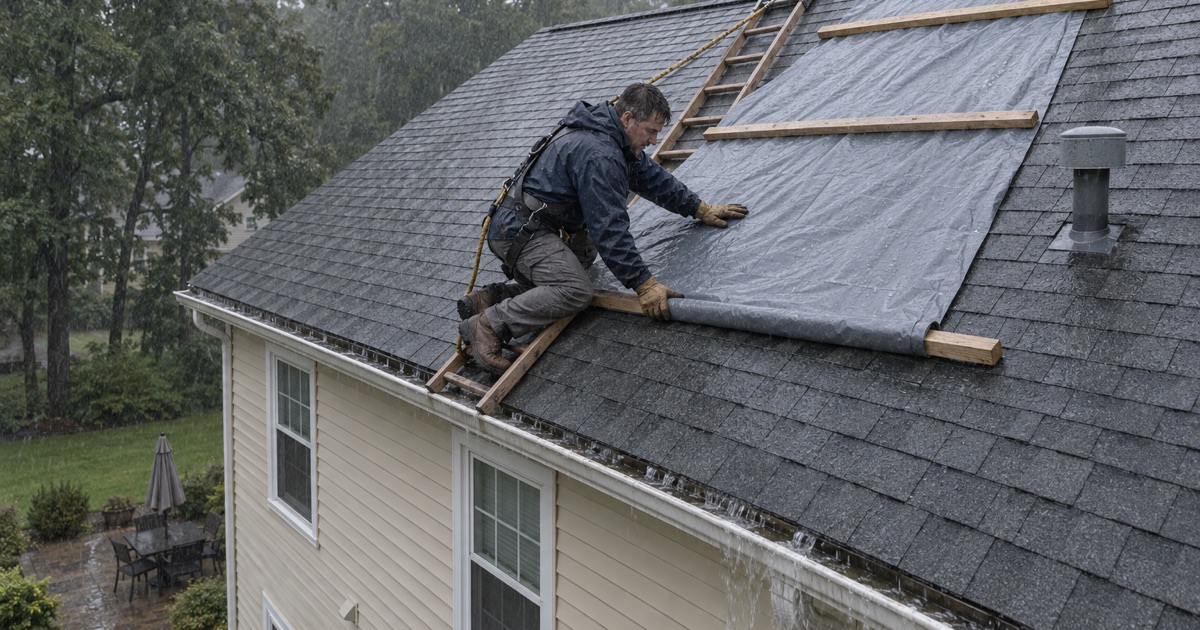
A tarp held down with a few bricks or nailed only at the edges will flap loose in the next gust. We run the tarp over the ridge where possible so water sheds over it, and fasten it with boards into solid framing. The goal is a cover that survives the next windy day.
We also try to limit new holes in the roof, placing fasteners where they will be covered by the permanent repair. The tarp is sized to cover the damage with plenty of overlap. Photos are taken before and after it goes on.
Temporary Patches on Flat Roofs
Flat and low-slope roofs need a different approach. A tarp on a flat roof can hold water rather than shed it. For punctures and opened seams on membrane roofs, a temporary patch compatible with the membrane is often the better short-term fix.
We clear drains and scuppers at the same time, since a clogged drain during a storm can turn a small leak into a flood. The temporary patch keeps water out until a proper repair can be welded or adhered. Commercial and multifamily repairs are then planned with any required permits.
Protecting the Inside of the House
Water that has already come in keeps causing damage after the leak is stopped. Wet insulation, drywall and carpet can grow mold if they are not dried. Ceilings that have held water may need to be opened to drain.
We point out where water has traveled in the attic so you know what to dry or remove. For major interior damage, a water mitigation company is often the right call. Acting in the first day or two makes a big difference.
Documenting Storm Damage for Insurance
Photos Before Anything Is Covered
Once a tarp goes on, the damage underneath is harder to show. We photograph the roof before covering it, with wide shots that show where the damage is and close-ups of each area. Interior damage gets photographed too.
Those photos, with dates, are often the best evidence you have of what the storm did. We write up the damage for your own claim and can meet the adjuster on site when you ask. Our role is to describe the roof accurately.
Receipts and Your Duties After a Loss
Most homeowners policies spell out what you are expected to do after a loss, including taking reasonable steps to prevent further damage. Keep receipts for emergency tarping, water removal and anything else you pay for. Read the duties-after-loss section of your policy.
The New Jersey Department of Banking and Insurance publishes storm claims guidance for homeowners. It is worth reading before you talk with an adjuster. Knowing the process makes it easier to keep your claim on track.
Who Can Negotiate Your Claim
Under the Public Adjusters’ Licensing Act, N.J.S.A. 17:22B, only a licensed public adjuster may be paid to negotiate a property claim for you. A roofer can document damage and meet the adjuster, but not negotiate. Be cautious of anyone who offers to handle your claim in exchange for a signed roofing contract.
If you hire a public adjuster, the contract must list their services and maximum fee. Many homeowners handle smaller roof claims on their own with good documentation. The choice is yours.
From Temporary Fix to Permanent Repair
Planning the Permanent Repair
After the emergency, we inspect the roof in daylight and dry weather and write up a scope for the permanent repair. The scope lists exactly what will be replaced, including any decking at a stated per-sheet price. If your insurer is involved, the adjuster’s inspection usually comes before the permanent work.
We schedule the repair as soon as the inspection and materials allow, since a tarp is not meant to stay up for long. When the repair is done, the area is cleaned up, including a magnet sweep for nails.
When an Emergency Means a New Roof
Sometimes storm damage reveals a roof that was already near the end of its life. Shingles that are brittle, decking that is soft in several places, or damage across multiple slopes can make a repair a poor investment. We tell you honestly when that is the case.
If replacement makes sense, the estimate is itemized so you can see each part of the job. Storm-damaged areas are documented separately from wear, which keeps your claim honest. You decide how to proceed with the full picture in front of you.
- 20+ Years in Business
- Attic Checked on Every Leak
- Itemized Written Scopes