
Old Bridge Roofing handles skylight installation in Old Bridge, NJ, serving surrounding cities including South River, Aberdeen, South Amboy, Holmdel and Highland Park, and in more than 20 years of roofing we have learned that how a skylight is flashed matters more than the unit itself. A skylight is a hole in the roof, and it stays dry only when the flashing around it is right. That is a roofer’s job.
We install new skylights, replace old ones, reflash units that are leaking, and remove skylights owners no longer want. Each job uses the manufacturer’s flashing kit, self-adhering ice and water barrier around the opening, and shingles woven in properly. Caulk is never the main line of defense.
The written scope lists the unit, flashing, framing and any interior work separately. You see exactly what you are paying for and what is included.
Types of Skylights
Curb-Mounted Skylights
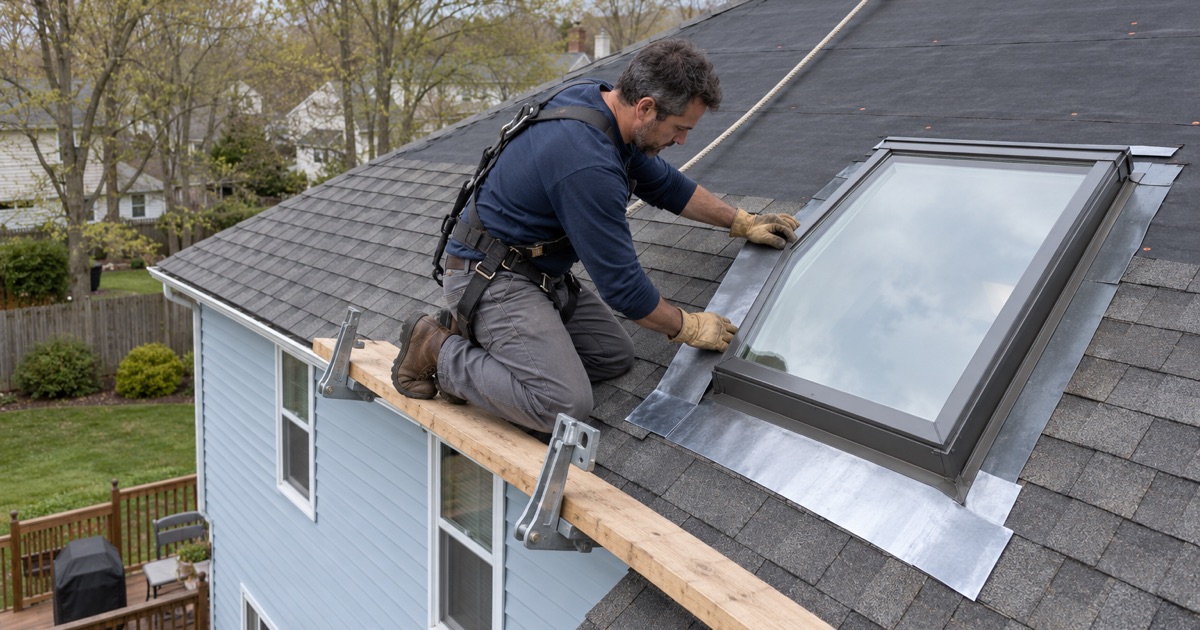
A curb-mounted skylight sits on a raised wooden frame, or curb, built on the roof deck. The unit fits over the curb, and the curb is flashed into the roof. This style is common on older homes and on low-slope roofs where the extra height helps shed water.
When replacing a curb-mounted unit, the new skylight must fit the existing curb or the curb must be rebuilt. We measure carefully before ordering. Flashing around the curb is replaced along with the unit.
Deck-Mounted Skylights
Deck-mounted skylights fasten directly to the roof deck and come with a flashing kit designed for that unit. They sit lower on the roof and give a cleaner look. Most new residential skylights are deck-mounted.
The flashing kit includes pieces that are woven into the shingles around the skylight. Installed with ice and water barrier underneath, this system is very reliable. Skipping or substituting parts of the kit is a common cause of leaks.
Tubular Skylights
Tubular skylights use a small dome on the roof and a reflective tube to carry daylight down into a hallway, bathroom or closet. They need a much smaller opening than a full skylight and do not require cutting a rafter. They are a good choice for interior rooms without windows.
The dome is flashed into the roof like a vent pipe, with its own flashing base. Inside, a diffuser spreads the light across the ceiling. Installation is usually quicker and less disruptive than a full skylight.
Fixed and Venting Skylights
Fixed skylights do not open and provide light only. Venting skylights open, either manually or with a motor, to let out heat and moisture. They are useful in kitchens and bathrooms.
Venting units have more moving parts and seals, so their quality matters. Some come with rain sensors that close them automatically. We help you choose the type that suits the room and how you plan to use it.
New Skylight Installation
Choosing the Location and Framing
Skylight placement depends on the room below, the attic framing and the roof slope. Fitting a skylight between rafters is simpler than cutting one, which requires adding headers to carry the load. Cutting rafters is structural work and generally needs a permit.
We check the attic framing before recommending a size and location. The rough opening is framed to the manufacturer’s dimensions. Getting this right makes the flashing fit properly.
Flashing Kit and Ice Barrier
Around the opening, we install ASTM D1970 self-adhering ice and water barrier, turned up the sides of the skylight frame. The manufacturer’s flashing kit then goes on, with the side pieces woven into the shingle courses and the head flashing lapped under the shingles above. Every piece laps in the direction water flows.
This layered approach keeps water out even if one layer is compromised. It is the same method used at chimneys and sidewalls. Done right, it does not depend on sealant.
The Light Shaft and Interior
Below the skylight, a light shaft runs from the roof opening to the ceiling. It has to be framed, insulated and finished. A well-insulated shaft reduces condensation and heat loss.
We frame and insulate the shaft as part of the job. Interior drywall finishing and painting are often handled by an interior contractor. We spell out in the scope which parts are ours.
Replacing, Reflashing or Removing Skylights
Reflashing During a Re-Roof
When a roof is replaced, every skylight should be reflashed, because the old flashing is tied into the shingles being removed. Reusing old flashing under new shingles is a common cause of leaks on new roofs. We replace the flashing with every roof.
If the skylight unit is in good condition, it can stay and be reflashed with a new kit. If it is older, fogged or has failing seals, replacing it at the same time is usually the better choice. We give you a straight recommendation for each one.
Replacing Fogged or Failing Units
Skylights that are fogged between the panes have lost their seal, which reduces insulation and clarity. Cracked glazing, failing seals and rotted frames are also reasons to replace. Older units may leak through the unit itself rather than the flashing.
We remove the old skylight and install a new one, adjusting the opening or curb if needed. New flashing and ice barrier go on with it. The result is a clear, sealed unit that should last.
Removing a Skylight and Closing the Opening
Some owners want to remove a skylight that leaks, overheats a room or is no longer wanted. We remove the unit, frame in the opening, sheath it and cover it with underlayment and ice barrier. Shingles are matched and woven in.
The ceiling below needs to be closed up as well. We frame and insulate the opening from inside, and finishing is often done by an interior contractor. Once done, the roof is continuous again.
- 20+ Years in Business
- Attic Checked on Every Leak
- Itemized Written Scopes