
Old Bridge Roofing handles roof repair in Old Bridge, NJ, serving surrounding cities including South River, Aberdeen, South Amboy, Holmdel and Highland Park, and we have been working on roofs for more than 20 years. Most of the calls we get start with a stain on a ceiling or a few shingles in the yard. Our job is to find the cause, fix that cause properly, and tell you honestly whether the rest of the roof has years left in it.
Every repair visit includes the attic as well as the roof. Water rarely drips straight down from where it gets in; it runs along rafters and the underside of the deck first, so the stain on your ceiling can sit several feet from the actual opening. Looking from inside and outside before we price anything is what keeps a repair from becoming a guess.
You also get a plain answer before replacement is ever mentioned. A roof with one failed pipe boot or a loose run of step flashing does not need to come off, and we will say so. When a repair would only buy a few months, we explain why and leave the decision with you.
Residential Roof Repair in Old Bridge
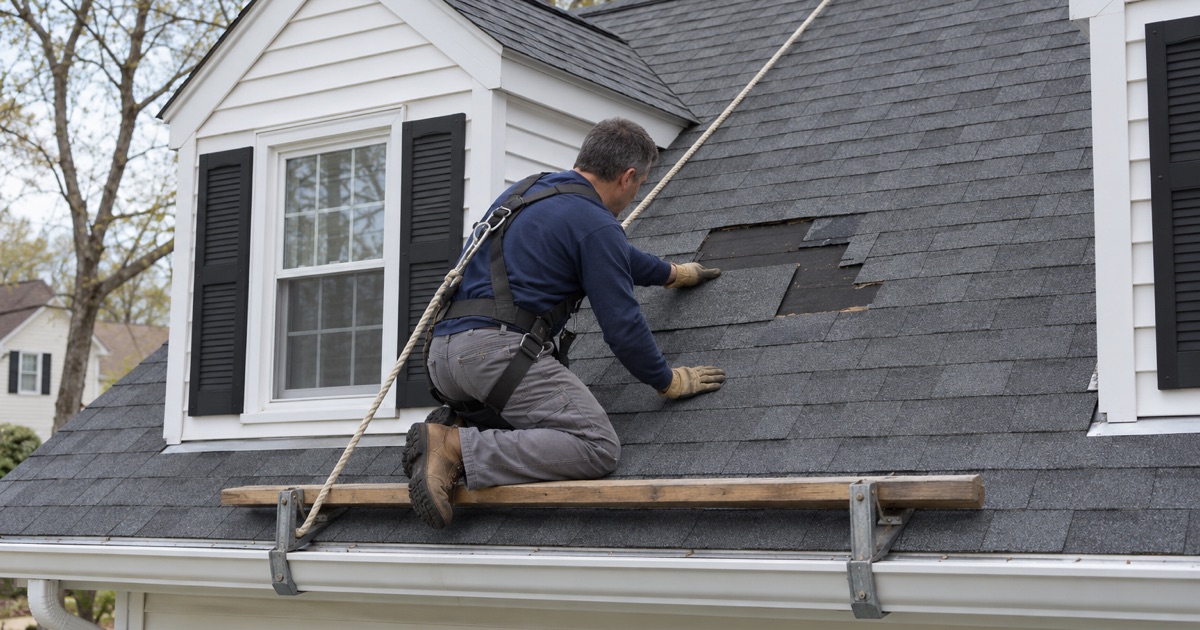
Wind-Lifted and Missing Shingle Repair
When a storm pulls shingles off, the ones in the yard are only part of the story. Shingles beside the gap have often lost their adhesive seal and are lifting in every gust, which is how a small loss turns into a larger one over the next few storms. We check the whole slope that faced the wind, not just the bare spot.
Replacement shingles are matched as closely as current production allows, nailed in the manufacturer’s pattern and hand-sealed where the original seal strip has failed. If the surrounding shingles have become too brittle to lift without cracking, we tell you, because forcing them is how one repair turns into three. In that case the honest answer may be a section repair or a full roof.
Flashing and Pipe Boot Repairs
Most leaks on an otherwise healthy roof start at a penetration. Rubber pipe boots crack after years of sun, step flashing along a sidewall loosens as the siding moves, and apron flashing at the bottom of a wall can be missing a kick-out that steers water into the gutter. These are small parts that let in a lot of water.
We replace a cracked boot with a new pipe boot or a lead flashing boot, rebuild step flashing piece by piece as the shingles are relaid, and add a kick-out where a wall meets the eave. Sealant is not the repair; it is a temporary cover that dries and cracks within a few seasons. Replacing the metal or the boot is what actually stops the water.
Repairs on Older Roofs from the 1960s and 1970s
Old Bridge grew quickly after the war, and many houses here date from the 1960s and 1970s, so we often repair roofs that have been replaced once or twice already. Some carry a second layer installed over the first, and some have flashing that was reused from an earlier roof rather than replaced. Each of those choices shows up later as a leak.
On these roofs we look closely at the decking around the repair, because older plank or plywood decking can be soft at the eaves and around chimneys. If the deck under a repair is rotten, nailing new shingles into it will not hold. We show you what we find, photographed, and price the deck work separately so you can decide.
Commercial and Low-Slope Roof Repair
Modified Bitumen Seams and Blisters
Torch-down SBS and APP modified bitumen roofs fail at the seams, at the flashing where the roof meets a parapet or curb, and where blisters have formed in the membrane. A blister that has split lets water into the layers below, and from there it travels under the membrane before showing inside. Finding the entry point takes patience on a flat roof.
We cut out damaged areas, dry the substrate, and heat-weld a new patch that overlaps sound membrane on every side. Flashing at walls and curbs is rebuilt rather than coated, because coating over a failed flashing only hides the gap. Commercial and multifamily roof work sits outside the detached-house ordinary-maintenance rule, so we check permit needs before starting.
EPDM and TPO Membrane Patching
EPDM rubber roofs usually fail at seams where the adhesive or tape has let go, or at punctures from foot traffic and dropped tools. TPO and PVC single-ply membranes have heat-welded seams that can open after years of expansion and contraction. Each membrane needs its own repair method, and mixing them up guarantees a short-lived patch.
On EPDM we clean and prime the area and apply a compatible patch with seam tape; on TPO and PVC we weld new membrane to old after cleaning the weathered surface. We also look at what caused the damage, whether it was a service technician’s path to a rooftop unit or ponding that keeps the seam wet, so the repair does not fail for the same reason.
Drains, Scuppers and Ponding Water
Water that sits on a flat roof for days after rain speeds up the aging of every seam it covers. Ponding usually comes from a clogged drain, a scupper set too high, or a deck that has sagged between joists. Repairing the membrane without fixing the drainage just sets up the next leak in the same place.
We clear and check drains and scuppers, then mark where water collects so you can see the pattern. Small low spots can sometimes be built up with tapered material during the repair. A sagging deck is structural work, and we will tell you plainly if that is what the water is pointing to.
Our Step-by-Step Roof Repair Process
Step 1: Inspect the Attic and the Roof
We start inside, looking at the underside of the deck, the rafters and the insulation for staining, mold or daylight. Then we go up and inspect the area above, including flashing, boots, vents and the shingles around them. Matching the two views is how we find where the water actually enters.
Step 2: Show You What We Found
You get photos of the problem from the roof and the attic, with a plain explanation of what failed and why. If more than one issue turns up, we list them in order of how urgently they need attention. Nothing is hidden on the roof where you cannot see it.
Step 3: Written Repair Scope and Price
The scope lists exactly what will be replaced, from the number of shingles or boots to the length of flashing and any decking at a stated per-sheet price. A written scope means there is no argument later about what the price covered. It also gives you something concrete to compare against another roofer’s quote.
Step 4: Repair, Clean Up and Check
We make the repair with matched materials, then clean the work area, gutters and yard, including a magnet sweep for nails. After the next heavy rain, check the ceiling and attic where the stain was. If water is still getting in, call us back so we can find what was missed.
When a Roof Repair Stops Making Sense
Signs the Whole Roof Is Worn Out
Shingles that are curling at the edges, cupping in the middle or missing most of their granules are worn across the slope, not in one spot. Leaks appearing in several unrelated places within a year or two point the same way. When we see those signs, a repair stops being a good use of your money.
We will still tell you if a repair can buy a season while you plan, because sometimes timing matters more than anything else. What we will not do is sell a string of patches on a roof that is finished. A clear answer now usually costs less than three repairs and a replacement anyway.
Soft Decking and Hidden Rot
Decking that flexes underfoot or crumbles at a nail hole means water has been getting in for a while. A repair on top of soft decking will not hold, because new nails have nothing solid to grip. Sometimes the rot is limited to one area around a chimney or valley and can be replaced as part of the repair.
When the soft areas are spread across a slope, the decking is telling you the roof covering above it has been failing for some time. We photograph what we find and show you before replacing any sheet. That way the decision about repair or replacement is based on the actual condition of the wood, not a guess.
Weighing Repair Against Replacement
The question is not only what a repair costs today but how many more repairs that roof will need. A roof with one isolated failure is worth repairing almost every time. A roof with repeated leaks, worn shingles and tired flashing will keep costing money until it is replaced.
We lay out both options when the answer is close, including what each would involve and how long the repaired roof is likely to serve. If replacement makes sense, the estimate is itemized so you can compare it line by line with any other quote. The choice stays yours, made with full information.
- 20+ Years in Business
- Attic Checked on Every Leak
- Itemized Written Scopes