
Old Bridge Roofing handles flat roof repair in Old Bridge, NJ, serving surrounding cities including South River, Aberdeen, South Amboy, Holmdel and Highland Park, and in more than 20 years we have repaired a great many low-slope roofs hidden on otherwise shingled houses. Rear additions, porches, garages and dormers often have roofs too flat for shingles. Those small membrane roofs leak more often than the main roof and are easy to forget until a stain appears.
Flat roofs leak differently from pitched ones. Water moves slowly, finds seams and edges, and can travel under the membrane before showing inside. We trace the leak from inside and from the roof, then repair the membrane system that is actually there.
You get a plain answer about whether a repair will hold or whether the low-slope roof needs replacing. Either way, the written scope lists the materials and the work clearly.
Where Flat Roofs Show Up on Houses
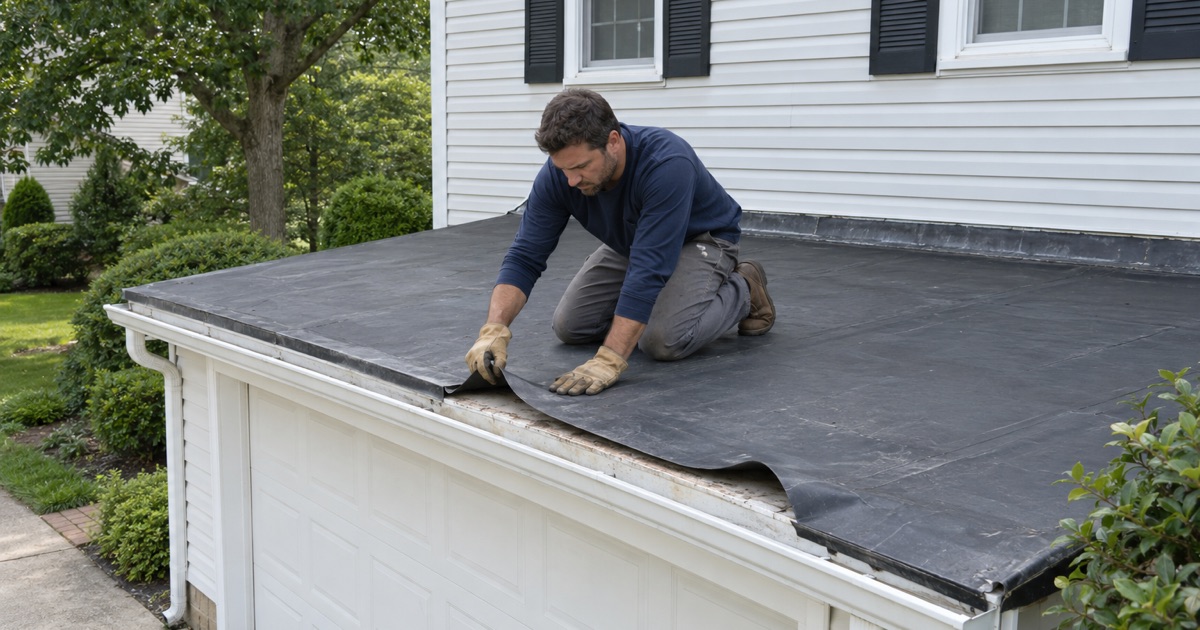
Rear Additions and Sunrooms
Many homes have a rear addition or sunroom with a nearly flat roof tied into the main house. The joint where that roof meets the wall of the house is the most common leak point. If the flashing there is short, unsealed or tucked behind siding incorrectly, water runs straight into the wall.
We check the wall flashing and any counter flashing above it, along with the membrane itself. Often, the membrane is fine and the wall joint is the problem. Correcting that detail can stop a leak that has been patched over and over.
Porch and Garage Roofs
Front porches and attached garages often have low-slope roofs covered with roll roofing, torch-down or rubber. These roofs see a lot of sun and often have poor drainage at the edges. Gutters on them are sometimes undersized or missing.
We repair the membrane, add or correct drip edge, and make sure water drains off the roof edge into a gutter. On a porch roof that is replaced, standing seam metal is another option where the slope allows it. We help you weigh the choices.
Dormers and Low-Slope Sections
Shed dormers and sections between gables sometimes have roofs flatter than shingles can handle. Shingles installed on too shallow a pitch let water back up under the laps, especially in wind-driven rain. Leaks from these sections often appear far from the actual cause.
We measure the slope and replace shingles on these areas with a membrane where needed. The transition between the low-slope membrane and the shingled roof above is flashed carefully. This fixes leaks that repeated shingle repairs never could.
Diagnosing a Flat Roof Leak
Ponding Water and Slope
Water that sits on a flat roof for days after rain ages the membrane and seams underneath it faster than the rest of the roof. Ponding usually means a clogged drain or scupper, a gutter set too high, or a deck that has sagged. Over time, even a small low spot becomes a leak.
We mark where water collects and look for the cause. Clearing a drain or lowering a gutter solves some problems right away. Others need tapered insulation or framing work to give the roof a proper slope.
Seams and Edges
Most flat roof leaks begin at a seam or an edge rather than in the middle of the membrane. Seams can open from age, poor installation or movement, and edges can lift in wind. Each membrane type has its own failure pattern at these points.
We inspect every seam and the full perimeter, looking for gaps, lifted laps and brittle edges. Problem areas are marked and photographed. Knowing where the seams are failing tells us whether a patch or a larger repair is needed.
Wall and Parapet Flashing
Where a flat roof meets a wall or parapet, the membrane turns up the wall and is covered by counter flashing. If the membrane does not run high enough, or the counter flashing has pulled away, water gets behind it. These leaks often show up as stains along an interior wall.
We rebuild these flashings with fresh membrane and secure counter flashing. On brick walls, counter flashing is set into the mortar joint. Getting the wall detail right is often what finally stops a repeat leak.
Wet Insulation and Soft Decking
Water that gets under a flat roof membrane can soak the insulation or the decking beneath it. Wet insulation stays wet for a long time and keeps feeding leaks inside. A soft spot underfoot is a sign the decking is damaged.
We probe suspected areas and open the roof where needed to check. Wet insulation is replaced, and damaged decking is photographed and shown to you before it is replaced. Patching a membrane over a wet roof only delays the next leak.
Repairing Each Membrane Type
Torch-Down Modified Bitumen
SBS and APP modified bitumen membranes are repaired by cutting out damaged areas, preparing the surface and heat-welding new material that overlaps sound membrane on all sides. Blisters that have split are opened and patched. The repair is built up to match the existing layers.
On houses, torch work near wood trim and siding requires care, and crews watch the area after torching. Where a flame is not appropriate, self-adhered modified bitumen can be used instead. The goal is a repair that bonds fully to the existing roof.
EPDM Rubber Repairs
EPDM rubber roofs fail mostly at seams where adhesive has aged and at punctures. Repairs involve cleaning and priming the area and applying a compatible patch or seam tape. Using the wrong materials on EPDM is a common reason patches fail.
We use materials made for EPDM and press them fully into place. Where flashing at walls or curbs has pulled loose, it is reattached or replaced. The cause of any puncture is noted so it does not happen again.
TPO and PVC Repairs
TPO and PVC single-ply membranes are repaired by heat-welding new membrane over the damaged area after cleaning the weathered surface. A good weld creates a joint as strong as the sheet. Seams that have opened are rewelded where the material is still sound.
Older single-ply membranes can become hard to weld as they age. If a weld will not take, we tell you, because that usually means the membrane is near the end of its life. In that case, replacement may be the better choice.
Repair, Coat or Replace
When Coatings Help
Roof coatings can extend the life of a flat roof that is still sound by reflecting sun and sealing minor surface wear. They will not fix failed seams, ponding or wet insulation. Applied over those problems, they only hide them.
We recommend a coating only after the leaks are repaired and the roof underneath is in good shape. Done at the right time, a coating can add years. Done at the wrong time, it is money spent on a roof that still needs repair.
- 20+ Years in Business
- Attic Checked on Every Leak
- Itemized Written Scopes